Fire-rated glass, cut to size and certified to BS EN 1364-1
From E30 to EI120, supplied in panels up to 1,388 by 2,389 mm. Speak to a fire-rated glass specialist about your project.

The basics
Fire-rated glass, fireproof glass, heat-resistant glass: what is the difference?
Fire-rated glass is a category of safety glass tested and classified for how long it can resist fire. The rating tells a specifier two things: how the glass performs, and for how long. "Fireproof glass" and "heatproof glass" are common search terms but neither is technically accurate. No glass is fully fireproof. All fire-rated glass eventually fails. The point of the rating is to give people enough time to evacuate, and to slow the spread of fire long enough for the building to be made safe.
Under European classification BS EN 13501-2, fire-rated glass falls into three groups:
E (integrity)
Stops flames, smoke and hot gases passing through. Does not control heat. The minimum standard accepted under UK Approved Document B.
EW (integrity plus radiation control)
As above, plus limits radiated heat to no more than 15 kW per m squared on the protected side. Used where heat transfer matters but full insulation is not needed.
EI (integrity plus insulation)
The highest tier. Stops flames, smoke and most heat. The unexposed face stays below safe-touch temperatures for the rated duration. Specified where people or combustible materials are close to the glass.
The number after the letter is minutes. EI60 means integrity and insulation maintained for at least 60 minutes. The longer the rating, the longer the protection - and the more critical the application.
Why the right rating matters: under-specifying creates compliance, insurance and life-safety risk. Over-specifying adds cost and weight without benefit. A good fire glass supplier helps you specify the right product first time.
What we can make
What we can make for your project
TG FR is processed and supplied to your specification. Cutting, edge work, lamination and any additional treatments are completed before tempering, which is critical: fire-rated glass cannot be cut after tempering. Like all toughened glass, attempting to cut it after the heat-treatment cycle will cause it to shatter. Build the spec right the first time and it arrives ready to install.
Standard processing options:
- Cutting and shaping to project drawings
- Polished, arrissed and other edge finishes
- Custom shapes, holes and cutouts
- Lamination, including with acoustic interlayers
- Combination with decorative interlayers
- Compatible IGU configurations
- Tested with all major fire protection profile systems
Lead times vary by rating, processing requirements and order volume. As a guide, straightforward E30 orders move quickly; EI60 and above with custom processing take longer. Speak to the team for a project-specific timeline before locking in a site programme.
- The required rating (E30, EI30, EI60, EI90, EI120)
- Total panel sizes and quantities
- Frame system the glass will be installed into
- Whether the panel is for a door, screen, window or partition
- Any insulation, acoustic or decorative requirements
- Site delivery date and address
If you do not yet have the spec finalised, send drawings or a project brief. The team will work the right product back from the application.
Before requesting a quote, have the following ready:
Ratings explained
Fire-resistance ratings: from E30 to EI120
Letter codes describe the type of protection. Numbers describe the duration in minutes. Classification is to BS EN 13501-2, with non-loadbearing glazed elements tested under BS EN 1364-1 and fire doors tested under BS EN 1634-1. Each rating below sits at a different point on the cost, weight and protection curve. Choose based on what the building, the regulator and the insurer require - not what is cheapest.

| Rating type | What it controls | Where it is used |
|---|---|---|
| E | Integrity only - flames, smoke, hot gases | Vision panels, lower-risk fire doors, screens where heat is not a concern |
| EW | Integrity plus radiated heat (max 15 kW per m squared) | Where occupants pass close to the glass but full insulation is not required |
| EI | Integrity plus full insulation (surface stays cool) | Protected escape routes, partitions, lobbies, anywhere people or combustibles are nearby |
Thirty minutes integrity against flames, smoke and hot gases. No insulation against heat. Toughened single-pane format, six millimetres thick. E30 is the minimum baseline accepted under UK Approved Document B for fire-resisting glazing. Typical applications include vision panels in fire doors, internal fire-resisting screens, and uninsulated glazed elements where size and location are limited under Appendix B, Table B5 of Approved Document B. Used in lower-risk areas where heat transfer to the protected side is not a concern.
E30
Thirty minutes integrity AND insulation. Toughened and laminated as standard, twenty-four millimetres total thickness. Suitable for double-glazed unit (DGU) configurations. Crucially, Approved Document B places no restriction on the area of EI30 glazing used - which is why it is the standard choice for non-domestic protected escape routes, internal partitions in offices and assembly buildings, lobbies and corridors. If the project calls for fire-rated glass with a meaningful design footprint, EI30 is usually the starting point.
EI30
Sixty minutes integrity and insulation. Toughened and laminated, thirty millimetres total thickness. Suitable for DGU and lamination configurations as standard. Typical applications: stair cores, protected lobbies and corridors, riser glazing, multi-storey commercial and public buildings with higher occupancy, and protected escape routes where extended evacuation time is part of the fire strategy. EI60 is the rating most often specified when EI30 is not enough but the building does not need maximum-rated compartment separation.
EI60
Ninety minutes integrity and insulation. Toughened and laminated, forty millimetres total thickness. Typical applications: compartment separation in larger commercial and high-rise buildings, hospitals and care facilities using progressive horizontal evacuation strategies, separation between high-risk and low-risk areas of a building, and basement-to-ground-floor separation. EI90 is where fire glass meets serious structural fire compartmentation.
EI90
One hundred and twenty minutes integrity and insulation - the highest standard performance tier in routine specification. Toughened and laminated, forty-eight millimetres total thickness. Vertical orientation only. Typical applications: high-rise buildings, critical infrastructure such as transport interchanges and air traffic control facilities, large compartmentalised commercial settings, and any building where extended evacuation time is required. Usually specified for fixed glazing rather than doors, because the weight at this rating is too much for standard door hinges to handle.
EI120 (vertical only)
TG FR is supplied across this full range. Each panel is certified individually, with production records maintained and available on request.
Where it is used
Where TG FR is specified
Fire-rated glass shows up across UK commercial construction. Five main areas account for the majority of TG FR enquiries.
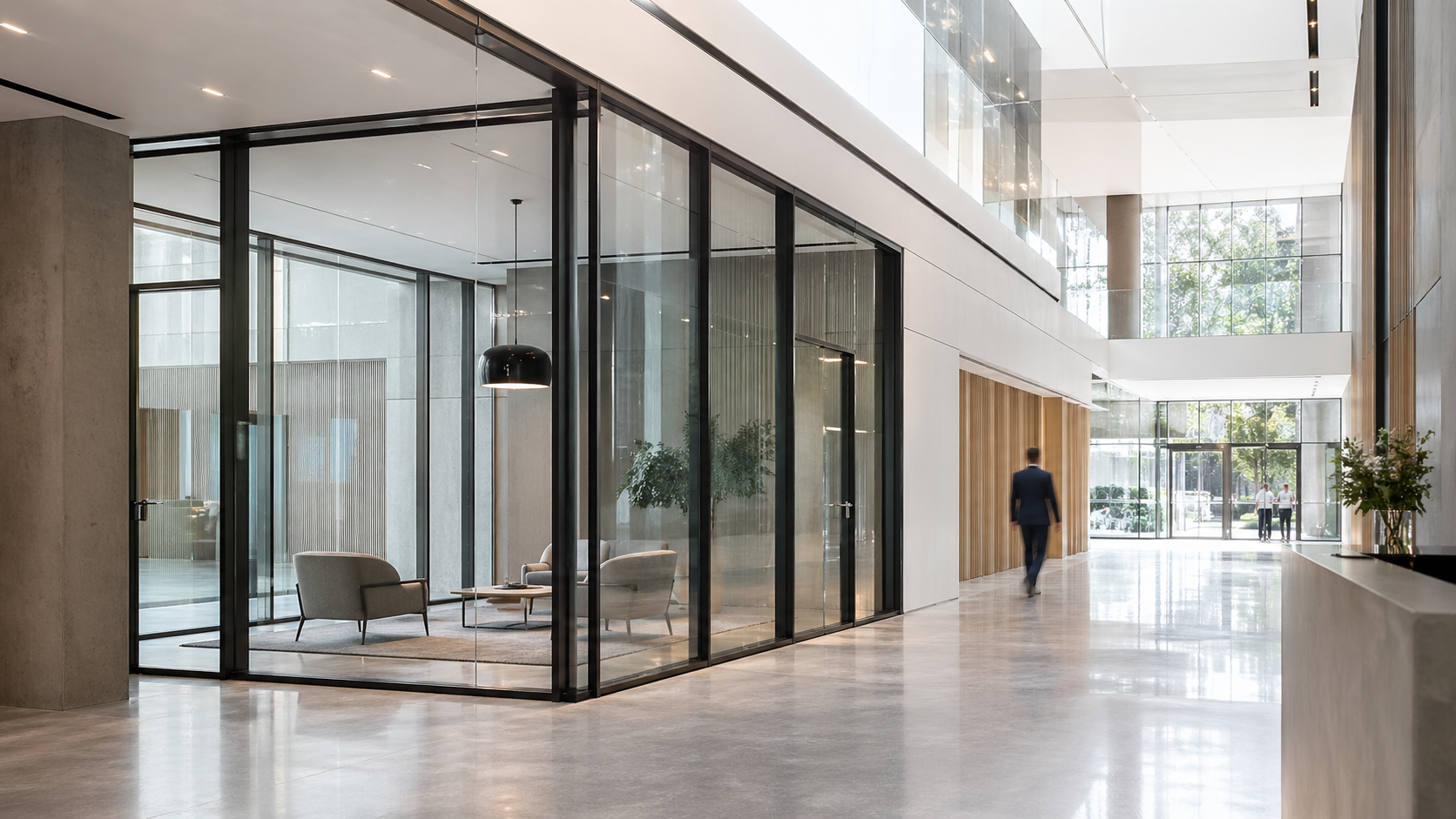
Fire-rated doors and screens
Vision panels, full-height glazed screens, internal door panels, and replacement glazing for existing fire doors. Where Approved Document B requires a door with an E30 or EI30 rating, the glass in that door must match. We supply E30 vision panels for fire door manufacturers and offer fire door glass replacement for facilities teams managing existing buildings. The whole assembly - door, frame and glass - has to perform as a unit. We help you specify the glass element correctly the first time.
Fire-rated glass partitions
Open-plan office subdivision, hospital ward dividers, escape route division in commercial fit-outs. Fire-rated glass partitions are a high-volume application because architects often want fire compartmentation without losing daylight or visual connection. EI30 partitions are the most common specification because there is no glazing-area limit under Approved Document B. EI60 partitions are specified where the building or fire strategy demands more. See our partition glass page for more detail on partition applications.
Fire-rated curtain walling and atrium glazing
Higher-rating territory. Atrium glazing, internal curtain walling between fire compartments, and feature glazing in high-occupancy commercial buildings. Specifications usually start at EI60. EI90 and EI120 are common in larger and taller buildings. Lead times tend to be longer than partition work because the panels are bigger, the frame systems are more specialist, and the install needs more coordination on site.
Fire-rated glazing for stair cores and lift shafts
Critical infrastructure within a building. Protected stairways are designed as virtually fire-sterile zones, and the glass that encloses them has to perform. Specifications typically range from EI30 in lower-risk buildings to EI90 or EI120 in tall, complex or higher-occupancy projects. Riser shafts (housing services) often require similar ratings depending on what services pass through. Get the rating wrong here and the building cannot be signed off.
Specialist sectors
Hospitals, schools, listed buildings, transport interchanges and infrastructure work. Each sector has its own specification quirks - hospitals often need progressive horizontal evacuation strategies that drive higher EI ratings; listed buildings need fire performance without disturbing the visual character; transport hubs need extended evacuation time, often EI120. The right supplier is one who has done the work before.
Why ToughGlaze
Why specifiers choose ToughGlaze for fire-rated glass
TG FR has been supplied to commercial projects across UK transport, healthcare, education, retail and infrastructure - delivered into projects of every scale, from single fire doors to multi-tonne specialist installations.
Two-hour fire protection in a single product.
TG FR is one of the UK's only fire-rated glass products that combines toughening, lamination and full EI120 performance with the optical clarity of standard architectural glass. Most fire-rated glass at this rating is cloudy, opaque or visibly layered. TG FR is not.
Specifiers who have used ToughGlaze before usually come back. The reasons are practical, not poetic.
In-house processing.
Cutting, lamination, edge work, tempering and final QC happen under one roof at our 197,000 sq ft facility. No third-party hand-offs that delay your site.
Certification per panel.
Each TG FR panel carries its own certification. Production records are maintained and available on request - which is what a building control officer or main contractor will want to see.
ISO 9001:2015 quality management.
Independently audited quality system. Adds confidence to the spec sheet.
Kitemark-approved.
TG FR carries the Kitemark for fire-rated glazing - an independent assurance buyers and inspectors recognise immediately.
In-house logistics.
Fleet of 30+ vehicles, FORS Bronze accredited. Glass leaves our yard in our trucks, on schedules we control. Less risk of a missed install slot.
Thirty years of UK glass processing.
Established in 1993. Trusted by commercial projects across the UK.
Same team, quote to delivery.
Talk to a specialist who knows fire-rated glass, not a generalist. The person who quotes your job follows it through.
How it is made
How TG FR is manufactured
TG FR is built around a piece of technology ToughGlaze developed in-house: a proprietary gel interlayer that delivers fire performance most laminated glass cannot match. The exact composition and processing method are kept inside the factory - not for marketing reasons, but because the science is genuinely the difference between a working EI120 panel and one that fails the test.
How the gel interlayer works in practice: when one face of the glass is exposed to fire, the heat triggers the gel to react. It absorbs energy, holds the panes together, and limits the amount of heat that can pass through to the protected side. That is what gives EI-rated TG FR its insulation performance. Without the right interlayer, you have toughened glass - which is strong, but which transfers heat freely. With it, you have a panel that can hold a 1,000 degree fire on one side while keeping the unexposed side cool enough to walk past safely.
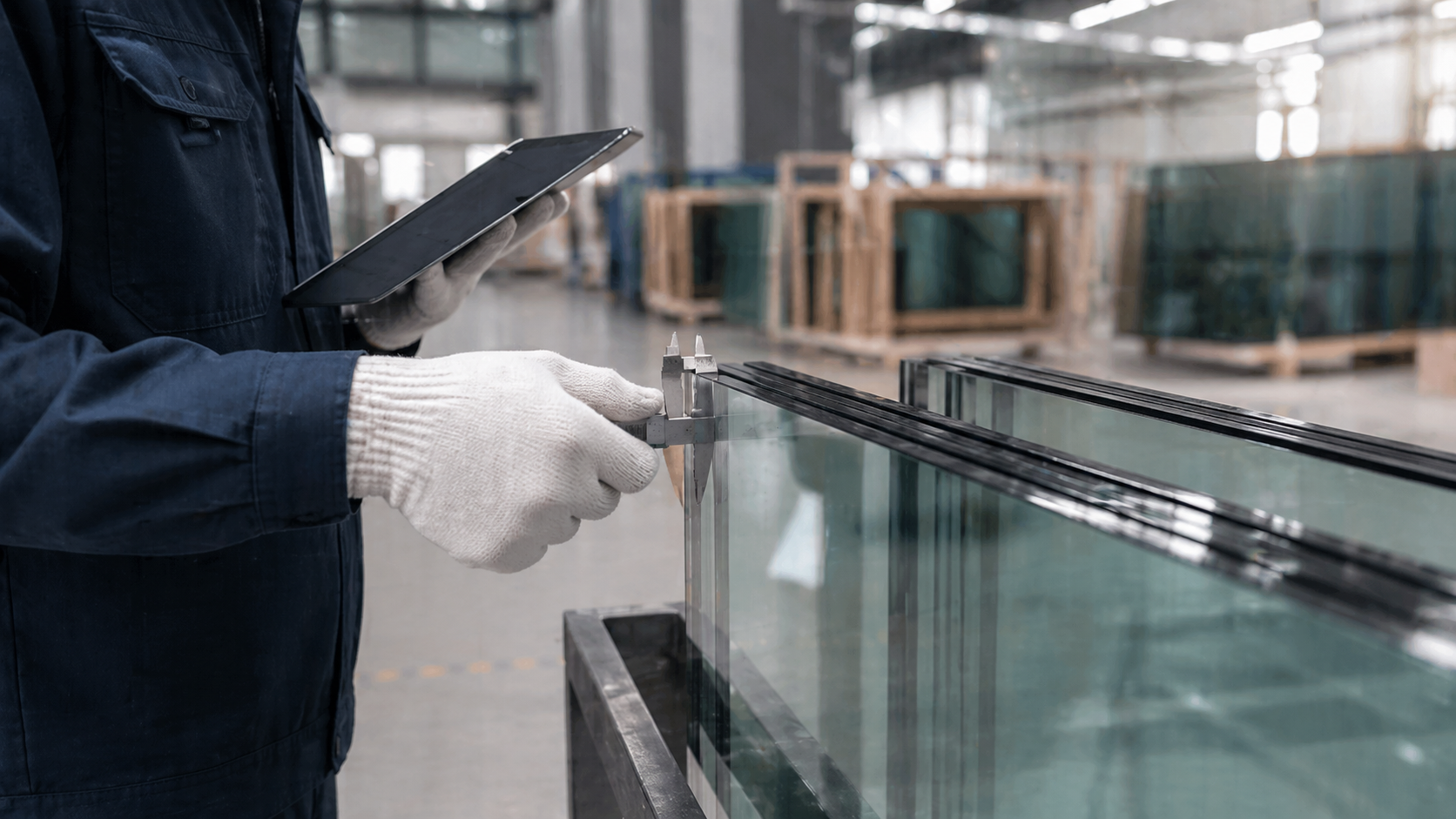
The full manufacturing sequence:
- Cutting and shaping to your project drawings.
- Edge finish applied (polished, arrissed or as specified) - critical for fire-rated performance.
- Calibrated tempering cycle developed specifically for TG FR. The thermal profile differs from standard toughened glass.
- For EI-rated panels: lamination using the proprietary gel interlayer. This is the step that determines whether the panel achieves EI30, EI60, EI90 or EI120 performance.
- Final testing and QC, with each panel certified to BS EN 1364-1:2015 performance and Kitemark approved.
Source glass is BS EN 572 certified float glass from the major UK and European manufacturers - known-quality material from the start. But the source glass is the easy part. The interlayer technology and the calibrated tempering are what make TG FR what it is.
Important point worth repeating: fire-rated glass cannot be cut, drilled or modified after tempering. All shaping, holes and cutouts have to be specified up front. If a site change demands a different size, it goes back through the full process - not a five-minute trim on site.
FAQs
Frequently asked questions
What is fire-rated glass?
Fire-rated glass is glass that has been tested and classified for how long it can resist fire under controlled conditions. The rating tells you what type of protection it provides - integrity, radiation control, or full insulation - and how many minutes of protection it offers. The main UK test method for non-loadbearing fire glass is BS EN 1364-1, with classification under BS EN 13501-2.
What rating is ToughGlaze TG FR fire-resistant glass?
TG FR is supplied across the standard UK rating range, from E30 through to EI120. Our entry-level TG FR is E30 and Ew15-rated, tested to BS EN 1364-1:2015 and Kitemark-approved. Higher EI-rated configurations use a proprietary gel interlayer technology developed in-house, which is what allows TG FR to deliver up to two hours of integrity and insulation in a single panel. Each panel carries its own certification.
How long does fire-rated glass actually last in a fire?
It depends on the rating. E30 maintains integrity for at least 30 minutes. EI60 maintains integrity and insulation for at least 60 minutes. EI120 lasts at least two hours under standard fire test conditions. Real-world performance varies - the rating is the minimum guaranteed under controlled testing, not a ceiling. The point of the rating is to give occupants time to evacuate and the fire service time to respond.
How is fire-rated glass made?
TG FR is made using a proprietary gel interlayer technology developed in-house at ToughGlaze. The source glass is cut and edge-finished first, then run through a thermal cycle specific to fire-rated production. EI-rated configurations are then laminated with the gel interlayer - the step that delivers the insulation performance under fire conditions. Every panel is tested and certified to BS EN 1364-1:2015. The full sequence happens at our UK facility.
Can fire-rated doors have glass panels?
Yes. Glazed fire doors are common, and the entire door assembly - including the glass - must meet the rating Approved Document B requires for that location. If the door is rated E30, the glass in it must also achieve E30. We supply vision panels and full glazed inserts for fire doors at the appropriate rating
Can you cut fire-rated glass?
Not after tempering. Like all toughened glass, fire-rated glass would shatter if cut after the heat-treatment cycle. We do all cutting, shaping and processing before tempering, which means TG FR can be supplied to any size or shape - it just has to be specified before manufacturing starts.
How much does fire-rated glass cost?
We do not publish prices because they vary too much. The four main cost drivers are: rating (E30 is cheapest, EI120 is most expensive), panel size, edge finish and processing, and whether the glass is laminated or part of an IGU. Send through your spec or drawings for a project quote.
Is fire-rated glass the same as toughened glass?
Not quite. Toughened glass is a strength rating - it has been heat-treated to make it harder to break and to break safely. Fire-rated glass is a performance category against fire. Some fire-rated glass IS toughened (TG FR is) - but most toughened glass is NOT fire-rated. They are tested to different standards and certified for different purposes.
Certification and documentation
Every TG FR panel is supplied with full documentation - production records, individual panel certification, and the relevant Declaration of Performance for the build-up specified. We keep records on file for every project we have processed, and we make them available on request.
Specifiers, building control officers and main contractors regularly need to verify the certification before sign-off. We have made this easy.
Download Declaration of Performance certificates for every TG FR build-up - from E30 through to EI120.