What causes glass anisotropy?
What causes glass anisotropy, why is it visible in toughened glass and can it be reduced? Explore the science behind this common optical effect.
Toughened glass is stronger and safer than ordinary annealed glass. But the process that gives it those properties can also create a distinctive visual effect.
That effect is known as
"anisotropy".
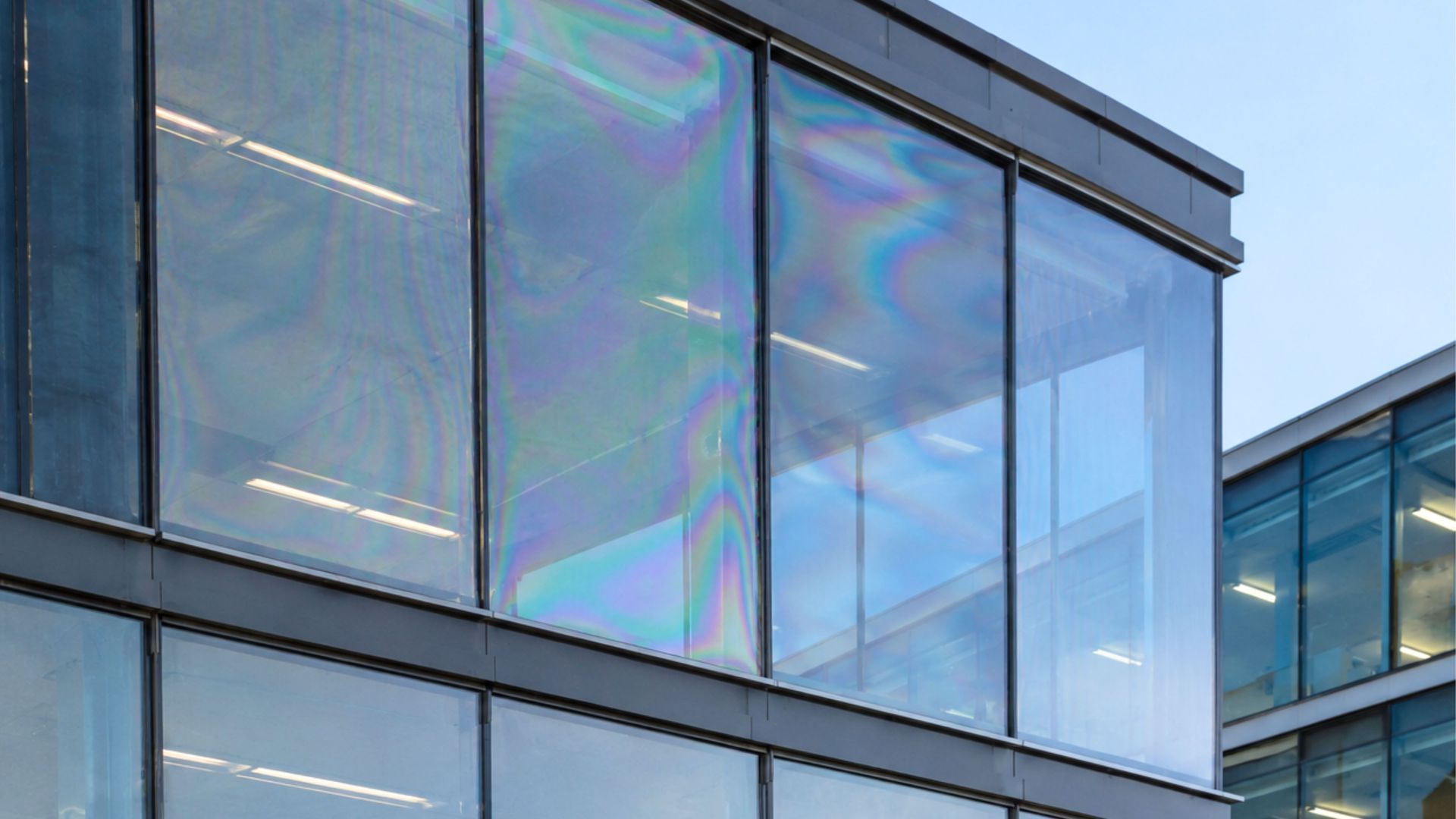
You may have seen it before without knowing the name. Under certain lighting conditions, toughened glass can show faint grey patches, dark bands, rainbow-like areas or irregular patterns across its surface.
These marks are not dirt, coatings or damage. They're the visible result of stresses created inside the glass during heat treatment.
Anisotropy is a normal characteristic of toughened and heat-strengthened glass. It can be minimised through careful processing, but it cannot be eliminated completely.
So, what causes it? And why is it sometimes far more noticeable than at other times?
What is glass anisotropy?
Ordinary annealed float glass is generally optically isotropic. In simple terms, light behaves much the same way no matter which direction it travels through the material.
Heat treatment changes that.
During toughening or heat strengthening, stresses are deliberately created inside the glass. These stresses improve its mechanical properties, but they can also affect how polarised light travels through different parts of the pane.
This phenomenon is called "birefringence", or "double refraction".
If the stress distribution across the pane isn't completely uniform, different areas affect light by slightly different amounts. Under the right viewing conditions, the human eye can see these variations as patches, bands or coloured patterns.
That's what we usually mean by anisotropy in architectural glass.
Pilkington describes the same phenomenon as a "stress pattern": spots or bars visible under polarised light because of slight variations in surface compressive stress.
What causes anisotropy in toughened glass?
The root cause is the heat-treatment process.
During toughened glass manufacturing, the pane is heated to around its softening temperature and then rapidly cooled, or quenched, using jets of air.
The surfaces cool first. The centre cools more slowly.
This creates compressive stresses at the surfaces and tensile stresses within the body of the glass.
That stress pattern is what gives toughened glass its increased strength and characteristic breakage behaviour.
The challenge is that heating and cooling a large pane with perfect uniformity is extremely difficult.
Small differences in temperature and cooling rate create small differences in residual stress.
These variations are what produce anisotropy.
Several factors can influence the final pattern.
Uneven heating
Glass must be heated as consistently as possible before it reaches the quench.
In practice, some areas can heat differently from others. Edges, corners, holes and cut-outs can all respond differently because their geometry affects heat transfer.
Large panes can be particularly challenging because maintaining exactly the same temperature across the whole surface becomes more difficult as dimensions increase.
Even with sophisticated modern furnaces, completely homogeneous heating
isn't realistically achievable.
Uneven cooling
The quenching stage is just as important as the heating stage.
Arrays of air nozzles rapidly cool the hot glass. Small variations in airflow, nozzle position or cooling intensity can produce local differences in the stress locked into the pane.
The resulting pattern can sometimes correspond to the arrangement of the quench nozzles. This is why anisotropy is sometimes described informally as "quench marks".
Research into heat-treated glass has identified airflow turbulence and variations around quench nozzles as possible sources of localised stress differences.
Rollers and furnace conditions
Most architectural toughened glass is processed horizontally on rollers.
As the glass heats and softens, contact with these rollers and its movement through the furnace can affect how heat is transferred across the pane.
Rollers can also contribute to another optical phenomenon called "roller wave", where softened glass sags slightly between supporting rollers.
However, roller wave and anisotropy are not the same thing.
Roller wave is a physical surface distortion that can make reflected images appear wavy.
Anisotropy, by contrast, is caused by variations in internal stress and their effect on polarised light.
The two can sometimes appear together because both result from heat treatment, but they have different causes.
Why can you only sometimes see anisotropy?
One of the more confusing things about anisotropy is that the same pane can look completely normal one moment and visibly patterned the next.
That's because the effect depends heavily on
polarised light.
Natural daylight can become partially polarised as it passes through the atmosphere or reflects from surfaces. The degree of polarisation changes with the weather, angle of the sun and viewing position.
As a result, anisotropy may become more noticeable:
- Under particular daylight conditions
- When viewing the glass from certain angles
- Against blue sky
- Through polarised sunglasses
- Under some artificial or LED lighting
So, a pane might appear clear during overcast conditions but show visible patterns on a bright day. This changing visibility is one reason anisotropy can become contentious on architectural facades.
Is anisotropy a glass defect?
Not necessarily.
Anisotropy is generally recognised as an inherent consequence of thermally heat-treated glass, not evidence that the glass has been incorrectly manufactured.
Industry guidance notes that anisotropy can occur in both fully toughened and heat-strengthened glass, and that current standards recognise its presence as an inherent characteristic of these products.
Of course, appearance is still important. On a large glazed facade – particularly one designed around highly uniform reflections – pronounced anisotropy can be visually undesirable.
Architects and facade consultants may therefore specify tighter aesthetic expectations or request additional quality control.
The important distinction is between anisotropy existing at all and anisotropy being unusually prominent. The former is inherent to the process. The latter can often be reduced.
Can anisotropy be prevented?
Not completely.
Because heat treatment deliberately creates stresses in glass, and because real-world heating and cooling are never perfectly uniform, you can expect some degree of anisotropy.
However, experienced processors can take steps to minimise its visibility. These include:
- Optimising furnace temperatures
- Controlling heating uniformity
- Fine-tuning quench pressure and air distribution
- Monitoring different glass sizes and thicknesses
- Maintaining rollers and furnace equipment carefully
- Using optical inspection systems to assess stress patterns
Modern inspection equipment can measure optical retardation, which provides a map of stress variation across a pane. This gives manufacturers useful feedback for adjusting furnace settings and improving consistency.
The aim isn't to produce glass with zero anisotropy. It's to control the heat-treatment process closely enough that the visual effect is kept as low as reasonably possible.
Do coatings make anisotropy more visible?
They can.
The visibility of anisotropy depends not just on the stress pattern inside the glass, but also on how light interacts with the finished glazing.
Research has shown that certain coatings can make quench marks appear more or less prominent under particular viewing conditions. The composition of an insulating glass unit can also affect how the phenomenon is perceived.
This is particularly relevant to architectural facades, where coated heat-treated glass is common and appearance may be carefully controlled.
It also reinforces an important point: the visible appearance of anisotropy isn't determined by one factor alone. Glass thickness, heat treatment, coatings, IGU build-up, light conditions and viewing angle can all influence what the observer sees.
Why does anisotropy matter to specifiers?
In many applications, it doesn't matter very much at all.
Anisotropy doesn't automatically mean the glass is weaker, unsafe or failing to perform its intended function. It is primarily an optical consideration.
But on prestige facades, shopfronts, large curtain walls and other visually sensitive projects,
appearance can be just as important as mechanical performance. That's why it's useful to discuss aesthetic expectations early.
If a project uses large areas of toughened or heat-strengthened glass, specifiers should understand that some degree of anisotropy may be visible under certain conditions. Where exceptionally consistent appearance is important, this can then be taken into account during procurement and processing rather than becoming a surprise after installation.
Heat-treated glass from ToughGlaze
At ToughGlaze, we process toughened and heat-strengthened glass for a wide range of architectural and commercial applications.
Heat treatment is a highly controlled manufacturing process, and factors such as pane size, thickness, coatings, edgework and final application can all influence the finished result.
If appearance is particularly important to your project, speak to our technical team early. We can discuss the required glass specification, processing considerations and the visual characteristics you should expect from heat-treated glazing.
Contact ToughGlaze today to discuss your project or request a competitive quote.