
Glass in landscape architecture: ideas, inspiration and products
Explore how glass can bring landscape architecture to life – and how toughened glass can play its role.

What do New York's Central Park, France's Gardens of Versailles and India's Taj Mahal all have in common? Answer: they're all world-famous examples of landscape architecture.
"Landscape architecture" is an umbrella term for the design of outdoor spaces. It ranges from small gardens to city centres with plenty more in between.
The aim is often to blend natural elements with built structures. Harmony, peacefulness and sustainability are the names of the game.
Landscape architects use all manner of materials to realise their visions – from naturally occurring materials like wood, stone and sand to manmade metals, concrete and ceramics.
For many landscape architects, glass is an integral ingredient in their outdoor creations. Perhaps it's the way glass creates space. Perhaps it's the way it reflects sky, scenery, people and animals. On a more practical level, perhaps it's the fact that it's so easy to maintain.
Whatever the reason, landscape architects need high-quality materials for the job. After all, these are materials that are going to have to withstand the elements – something that not all glass products can handle.
Here at ToughGlaze, we're passionate about the creative potential of glass, whether in a domestic, commercial or landscape setting. All our glass products can be cut to size and processed in a wide range of colours, finishes and textures.
In this article, we explore the creative potential of glass in landscape architecture. We hope it gives you some inspiration.
How glass is used in landscape architecture
Glass is used in landscape architecture in a wide variety of ways. Sometimes, it's used for surfaces, whether flat or curved. Other times, it's crushed into pieces.
Glass panels
Some landscape architects like to use large glass panels as screens. These can be etched, frosted or digitally printed with text or images. Alternatively, they can be transparent or translucently coloured.
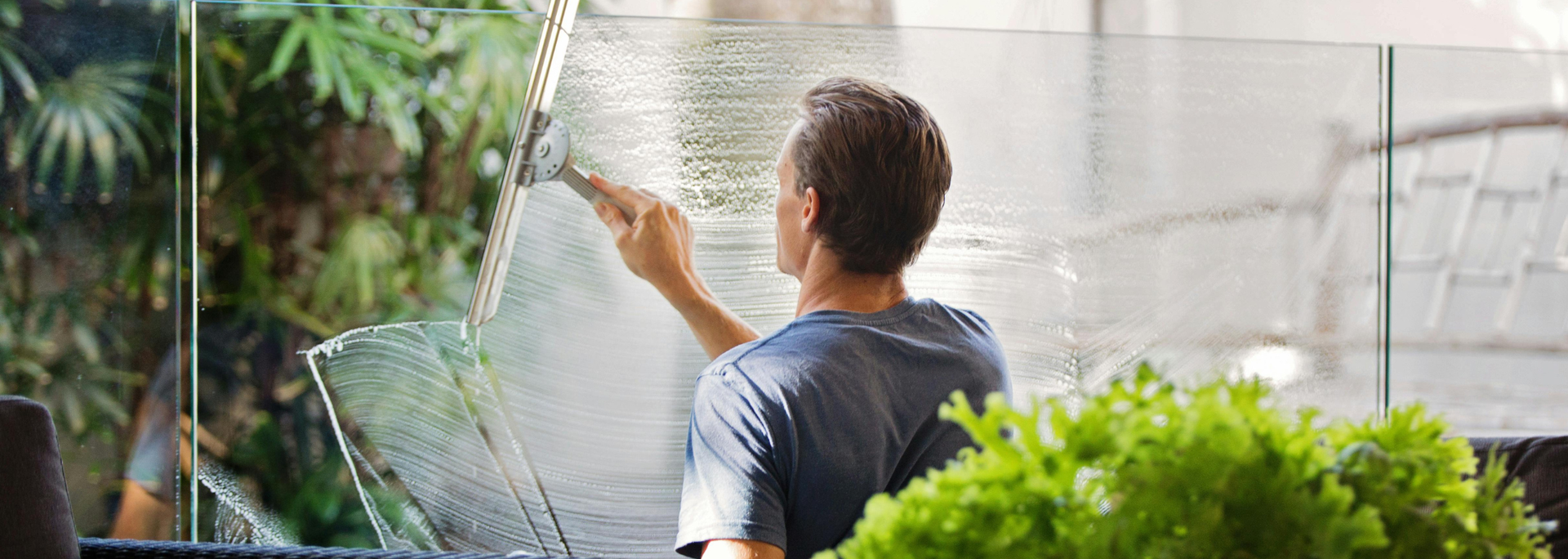
Glass panels can be used to create structures like greenhouses, tabletops and see-through fences. When installed in conjunction with foliage, these act both as a protective barrier and as a means of focusing attention.
In landscapes with flowing water, glass can mimic those curves and colours. You could have a glass walkway across a river, a glass fountain or glass sculptures next to water features.
Crushed glass and glass pebbles
Landscape architects don't just use glass panels. They also use crushed glass as mulch or gravel.
Glass mulch is made from crushed and tumbled cullet (recycled glass). It suppresses weeds, helps retain water and acts as a colourful – and environmentally friendly – alternative to traditional mulch. It can be used in borders, rock gardens and pretty much anywhere that plants grow.
Meanwhile, pathways can be laid or edged with glass pebbles or crushed glass. Sometimes combined with traditional gravel, these glass particles can be multi-coloured to create enchanting sparkling effects.
Light-harnessing effects
Landscape architecture often makes use of both natural and artificial light. Natural light is harnessed while artificial light creates poetic effects in the evening and at night.
This is something that can be achieved with glass. A glass balcony, for instance, could be
fitted with LED lights – or a
glass partition in front of a water feature. A glass railing – often used to preserve sight lines on decking and other raised areas – could light up in the dark.
And more…
We can't cover all the possible applications of glass in landscape architecture. But no list would be complete without mentioning the inclusion of glass panels digitally printed or screen printed with photorealistic scenes from nature. We hope you've got the impression that the uses of glass in landscape architecture are diverse, creative and inventive. But what kinds of glass products do you need to make it possible?
What kinds of glass are used in landscape architecture?
When sourcing glass for landscape architecture projects, it's essential to remember that the glass is going to be outside, whether partially or fully.
These days, most glass products can withstand the elements to a degree. However, if a piece of glass is going to be used as a permanent outdoor fixture, it needs to be super-durable.
Beyond this, the specific type of glass chosen for an installation will depend on two requirements: safety and aesthetics.

Toughened glass
Toughened glass (also known as "tempered glass") is a high-strength kind of safety glass. It's exceedingly hard to break – and when it does break, the manufacturing process ensures that it shatters into tiny and relatively harmless pieces.
Toughened glass is used for all sorts of applications. Its resistance to impact, wind pressure and high temperatures makes it ideal for landscape architecture. It's often used as
glass for balustrades, pool fencing, doors and screens.
Laminated glass
The other most commonly used type of safety glass is laminated glass. Whereas toughened glass consists of one layer, laminated glass is a unit made from two layers and a plastic interlayer. This interlayer means that when the unit breaks, it retains its structural integrity.
This super toughness makes it ideal for two outdoor applications. The first is installations in areas prone to hurricanes and other extreme weather. The second is when the glass needs to bear a load. In the context of landscape architecture, this includes walkways, balconies and glass screens.
IGUs
If the landscape architecture project includes a structure such as a conservatory, the glass is likely to be toughened glass, laminated glass or an insulated glass unit (IGU). These double- or triple-glazed units trap gas or air between the panes. This gives them the thermal efficiency they require (and acoustic insulation if the structure is for human use).
Decorative glass
Like all toughened and laminated glass, glass in landscape architecture can be tinted, frosted or patterned in a wide variety of ways. It can also be curved – a type of glass favoured by architects who want the glass to mirror the landscape.
Finally, landscape architects use tumbled crushed glass for pathways, borders and other places where gravel might otherwise be used.
Are you looking for high-quality
decorative glass products for a landscape architecture project? At ToughGlaze, we can cut, shape and process glass in dozens of visually appealing ways – all from our state-of-the-art UK facility.
Get in touch with our experts to discuss your project or request a quote today.