
Interior design: mesh-laminated glass vs perforated metal screens
Looking for metallic textures in an interior design project? Explore the pros and cons of mesh-laminated glass and perforated metal screens.
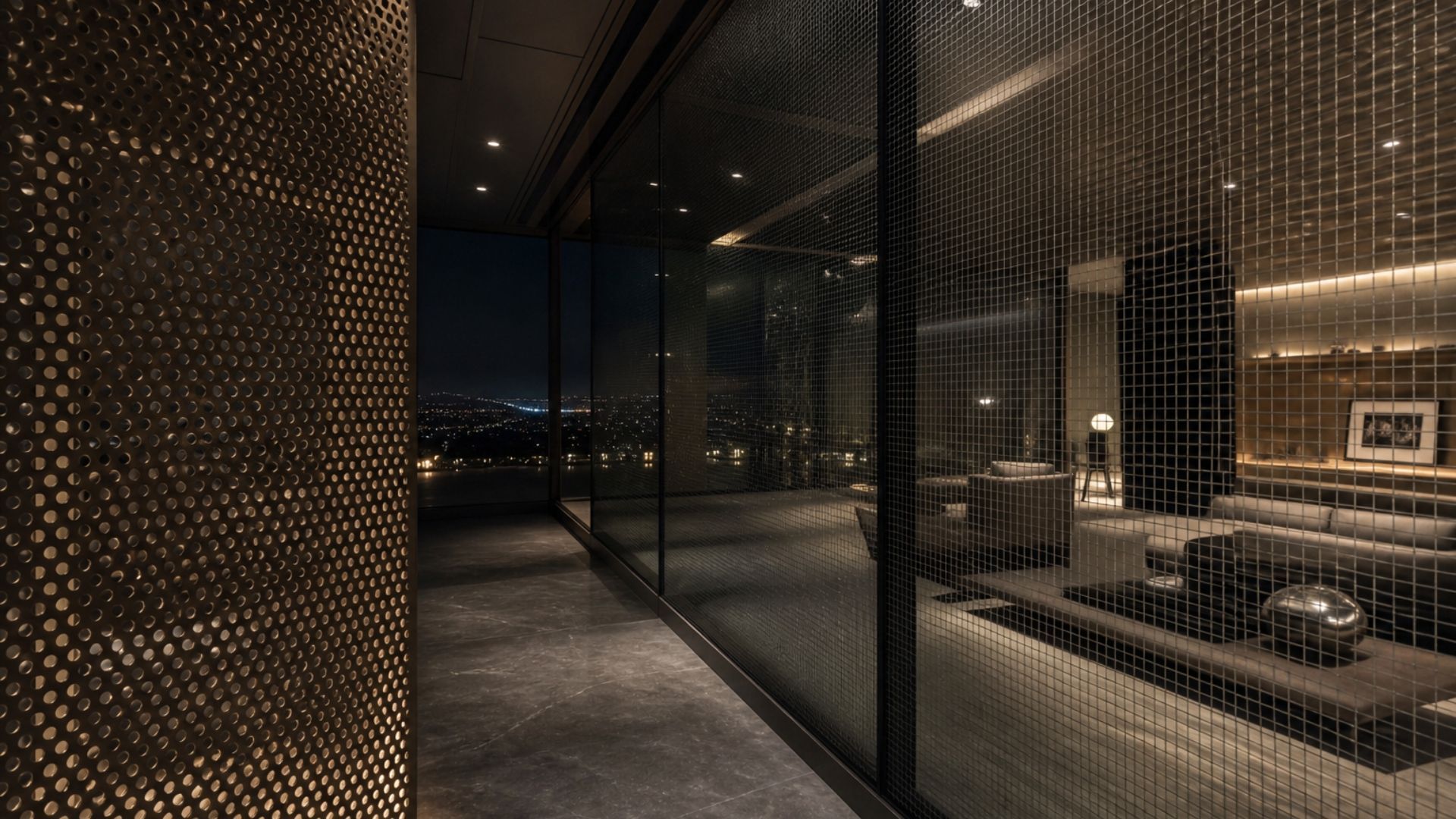
Interior design is a world of possibilities – possibilities of materials, styles and juxtapositions. But as with everything in life, with each of these possibilities comes a choice.
Choosing between features, colours or materials can be hard. Successful choices often arise from a combination of instinct and a sense of the bigger picture – the total effect of all the components dancing together. This requires, for want of a better word, vision.
Visions, however, tend to be aesthetic. But choices in interior design are never purely aesthetic. This is because pretty much all interior design features are functional as well as aesthetic.
Take the choice between
mesh-laminated glass and perforated metal screens. Both provide architects and designers with metallic mesh textures. These can be used to create a range of stylistic effects, from rugged industrialism to delicate impressionism.
Glass and metal, however, are structurally and functionally different. Both are robust, sure. But in many ways, glass is a more versatile, longer-lasting and structurally complex material than metal.
It's these kinds of considerations that lead architects and designers to their final choices. In this article, we look at the distinctions that might lead you to choose one over the other.
What is mesh-laminated glass?
Mesh-laminated glass is a decorative and functional form of
safety glass.
Safety glass is either toughened (tempered) or
laminated glass. These are robust types of glass that break safely and are often mandated for use in "critical" safety locations.
In the case of mesh-laminated glass, a metal mesh interlayer is bonded between two or more glass sheets. The mesh could be stainless steel, copper, brass, aluminium or bronze.
It's a high-end product that often results in sophisticated textures. More often than not, it's used for privacy screens, partitions, balustrades and
deluxe furniture.
Also known as "mesh-interlayer glass" and "laminated wire mesh", it has functional traits as well as aesthetic ones. These include sound-reducing insulation, reduced glare, enhanced safety and improved durability.
What are perforated metal screens?
Perforated metal screens are a popular choice for architects and designers as an alternative to glass. They are strong, durable and can be installed inside or outside.
In offices and public spaces, such as shopping centres, perforated metal screens are frequently used for balustrades, mezzanines, railings and walkways. In the world of architecture, they're used for building facades, acoustic ceiling panels, sun screens, fences and privacy screens.
In industrial settings, you might see perforated metal screens used for ventilation grilles or acoustic panels for machinery. These, however, don't function as an aesthetic alternative to mesh-laminated glass. Instead, they play a purely functional role.
Perforated metal screens can be manufactured with a variety of hole shapes. These holes can be round, square, rectangular, diamond-shaped or even bespoke patterns.
Perhaps the main benefit of perforated metal screens is that they provide durable and lightweight structural integrity while letting air, light and sound pass through.
That's the main difference between metal screens and mesh-laminated glass. While metal screens let air and light through, mesh-laminated glass acts as a barrier against the elements. It combines the strength of laminated glass and the aesthetics of woven metallic textures.
Like mesh-laminated glass, perforated metal screens can be aluminium, steel, bronze, brass or copper.
Which is better for your project?
We started by talking about choices. So, which is right for your project, mesh-laminated glass or perforated metal screens?
If you're simply looking for a mesh-style aesthetic, perforated metal screens can do the job nicely. They provide structural integrity and aesthetic appeal while letting through air, sound and light.
If, however, you want to harness all the advantages of safety glass, mesh-laminated glass is the way to go.
This gives you beautiful woven-style textures along with superior impact resistance. It takes a lot of force to break laminated glass, and when it finally does break, it's designed to stay in its unit. This can help reduce the chances of injury from falling glass.
The sturdiness of mesh-laminated glass makes it ideal for high-end, high-traffic environments such as hotels, restaurants and shops.
On top of this, mesh-laminated glass is thermally efficient. At a time when sustainability is at the top of so many designers' agendas, this can be invaluable.
Essentially, mesh-laminated glass combines safety glass and metal screens into a highly durable, highly attractive unit, giving designers and architects the best of both worlds.
What is laminated glass?
Mesh-laminated glass is a subcategory of laminated glass. This is a type of glass consisting of at least two panes of glass with plastic interlayers in between.
The interlayers can be
coloured,
fire-rated or given
soundproofing properties. In the case of mesh-laminated glass, a woven metallic layer is also sandwiched between the panes of glass.
Laminated glass is super-strong. There's a reason it's the glass of choice in hurricane-prone areas. It's also highly thermally efficient, making it a product of choice for many designers with environmental goals in mind.
What are the advantages of glass in interior design?
Mesh-laminated glass is good for specific purposes. But glass in general has many benefits for interior design.
Perhaps the best of all is that it maximises natural light. Again and again, research has shown that natural light is good for humans. And, in the context of interior design, it creates environments that are bright, healthy and productive.
On a similar note, glass offers a window (literally) onto the natural world. The interior becomes connected with the exterior, creating positive vibes and a sense of groundedness.
What's more, glass can make small rooms feel larger – a valuable quality in boutique shops, hotels and restaurants.
Finally, it's often used to create sleek, sophisticated surfaces. In many cases, this simultaneously provides a timeless and trendy look.
Are you looking for high-quality mesh interlayer glass for an interior design project? Get in touch with ToughGlaze today for a quick, competitive quote or to discuss your needs in detail.