Architecture guide: using mesh-laminated glass for solar shading
Does your architectural project require solar shading? Find out how mesh-laminated glass can help you effectively control light and heat.
Architects work with the elements. It's no exaggeration to say that you can't design a building without considering the Sun.
Yes, that mighty ball of fire in the sky is as big an influence on an architectural project as any stakeholder. Buildings need to be the right temperature all year round. And while some of that can be solved through heating systems, the building itself plays a pivotal part, too.
Take solar shades. Sometimes described as "sunglasses for your windows", these are specialised roller blinds or pieces of glass that control the amount of light and heat that can get in.
By controlling light and heat, they also control the building users' exposure to ultraviolet (UV) rays. Furniture is kept from fading, screen glare is minimised and energy efficiency is improved.
Solar shading comes in different forms. One especially aesthetically appealing option is mesh-laminated glass. This gives you high performance and high aesthetic impact in one durable package.
So, before we take a look at how mesh-laminated glass can help with solar shading, what is mesh-laminated glass, exactly?
What is mesh-laminated glass?
As the name suggests, mesh-laminated glass is a kind of laminated glass. This, in turn, is a type of safety glass made from two or more sheets of glass with a plastic interlayer.
Laminated glass is manufactured in this way to increase its durability. Laminated glass is around six times as strong as standard annealed glass. And when it finally breaks, the damaged pane of glass is designed to stay in its unit. This means a broken piece of glass won't lead to avoidable injuries from falling shards.
Mesh-laminated glass takes the form of laminated glass as we know it and does something new and exciting with it. In this new application, a metal mesh is sandwiched between the panes of glass and then bonded with a plastic interlayer.
The mesh can be made from brass, copper, steel or aluminium, among other kinds of metals. It gives you soft, woven, metallic textures with no compromise on safety or durability.
This makes it a popular option in a wide range of architectural applications. But as well as being tough and easy on the eye, mesh-laminated glass helps with solar shading – a key concern for architects, especially in hot climates.
How does mesh laminate improve solar shading?
By its very nature, mesh-laminated glass can improve solar shading. This is because the metallic woven mesh bonded between the panes acts as a translucent, reflective and absorptive barrier.
It acts like a pair of sunglasses, maintaining the flow of light while minimising glare and (somewhat less like a pair of sunglasses) reducing heat gain.
Some types of mesh-laminated glass can reduce the transmission of solar energy by more than 90%. In this respect, it acts as a kind of passive sunshade – but one that demands no sacrifice of aesthetic value.
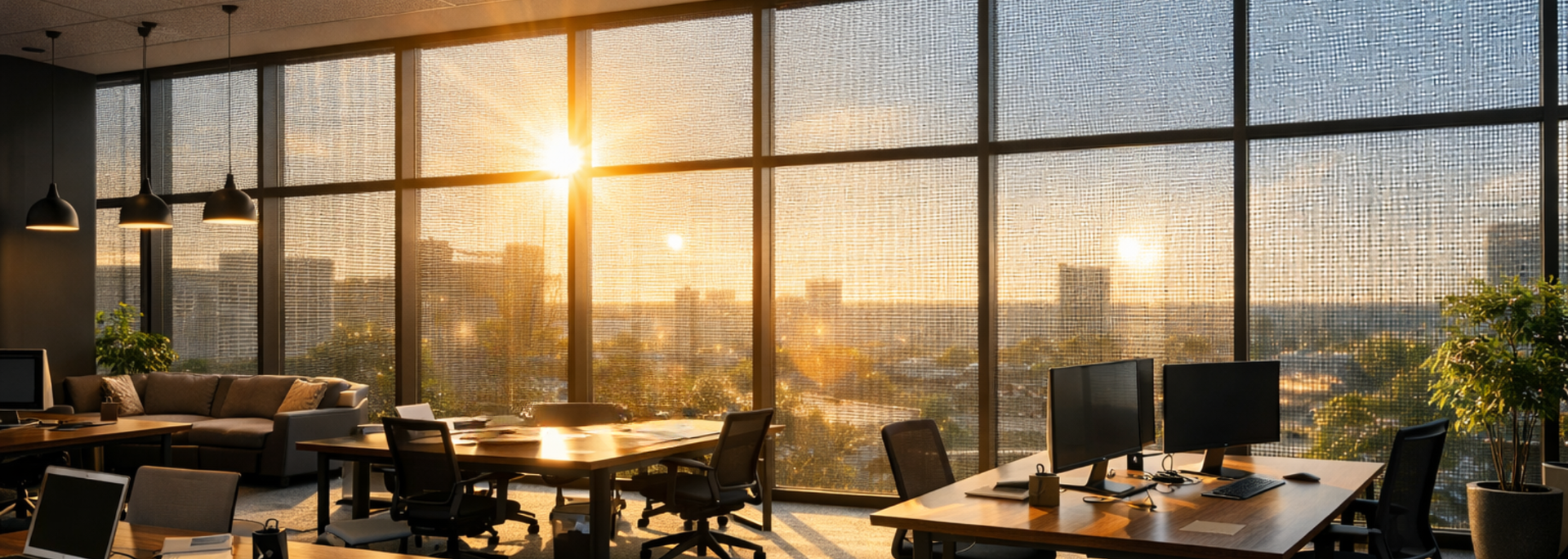
The mesh reduces the amount of heat entering the building. This reduces the load on HVAC systems and can help improve energy efficiency, especially in conjunction with other energy efficiency measures.
The laminated nature of mesh-laminated glass means it blocks over 99% of ultraviolet (UV) rays. This stops furniture from fading as well as protecting building users from harmful rays.
Mesh-laminated glass helps building users in another way. It diffuses the light, creating a more comfortable indoor environment with less glare.
Finally, many meshes appear decorative from the outside and see-through from the inside – at least when viewed from a reasonably close position. This protects the privacy of building users while maintaining their view of the outside world.
Where can mesh-laminated glass be used for solar shading?
Mesh-laminated glass can be used in a variety of architectural applications for better solar shading. These include:
- Building facades and curtain walls
- Skylights and other overhead glazing
- Windows and doors
- Balustrades and balconies
- Internal partitions and screens
- Canopies
It can also be combined with insulating glass units (IGUs) for maximum performance.
It can't, however, be used everywhere. This is mostly due to fire regulations and thermal stress risks.
Laminated glass systems are restricted on external walls and balconies on high-rise residential buildings.
When used in the external walls of high-rise residential buildings, schools and some other institutional buildings, the glass will need a fire-rated interlayer rather than a standard PVB interlayer. This precludes the use of a mesh interlayer.
When exposed to partial or uneven shading from balconies, trees or overhangs, mesh-laminated glass needs to be analysed for thermal stress. This is because these applications are more susceptible to thermal breakage.
Finally, mesh-laminated glass shouldn't be used as an internal shading device, such as an interior blind directly behind another pane of glass. Again, this is because of the risk of thermal breakage.
Why is solar shading in architecture important?
Mesh-laminated glass is good for solar shading. But why is solar shading good for buildings?
The answer is multi-faceted. Solar shading helps stop buildings from overheating. It maximises the amount of natural daylight entering a building. And it makes life better for building users by reducing glare.
On top of this, it means building users reach less often for the air con, improving energy efficiency and supporting sustainability goals.
And like all of the best advances in glass fabrication, it does this while looking good and adding decorative interest to buildings of all styles. It's another great example of how glass so winningly combines form and function.
Are you looking for high-quality mesh-laminated glass? Here at ToughGlaze, we cut, process and deliver best-in-class mesh glass to clients in a range of sectors. Get in touch today to discuss your needs or request a quick, competitive quote. We look forward to providing the materials you need for the job.