Can architectural glass be truly circular?
Can architectural glass truly be circular? Explore its carbon impact, recycling challenges and the path towards more sustainable building materials.
As a material, glass has quite a compelling story to tell.
Natural-forming glass occurs in the statistically rare, the spontaneous, the almost magical. Rapid-cooling volcanic magma. Lightning striking in the desert. The hypervelocity impact of meteorites, comets and asteroids.
The manmade process relies on the same concept. Expose materials to shock (usually very high heat), and they will melt, combine, and ultimately cool into the glass we recognise.
Due to its easy formability and reflective, refractive and transmissive properties, glass has quickly become embedded in humanity's history. From drinkware to vision correction – whatever the problem, there's a type of glass to solve it.
But glass has a problem of its own: the strive for circularity.
In principle, glass can be recycled an infinite number of times without compromising the quality. However, the reality of making glass circular is more complicated than simply putting it in a recycling bin.
Architectural glass has unique challenges in this conversation. Let's explore them.
Architectural glass is complicated
Nature, as we've seen, can form glass in rare circumstances. But for humans to recreate this process, it's both complex and energy-intensive.
Float glass, typically used for windows and panelling, is created by heating soda ash, limestone, dolomite, sand and salt cake to around 1,500°C (2,730°F). It's then stabilised at around 1,200°C (2,190°F) before forming.
Later, vitreous enamels add colours, designs and additional layers to the transparent base.
Most forms of specialised glass, such as toughened, laminated and acoustic glass, consist of standard float glass that has been further processed.
These techniques are fundamental to how architects use glass to enhance buildings aesthetically whilst reducing energy consumption. However, the truth is that the product is complex in virgin form and even more so when other materials are involved.
All this can make it harder for architectural glass to be circular.
Looking at the lifecycle
To understand true circularity, we must look at the whole lifecycle of architectural glass.
For architects, developers and commercial building owners working towards sustainability targets, the important question is not whether glass is inherently sustainable or unsustainable. Rather, we should ask, "How can the material be manufactured, used and ultimately recovered at the end of a building's life?"
That means looking at carbon costs at every stage in the life of the glass – starting with manufacturing.
Glass has an upfront carbon cost
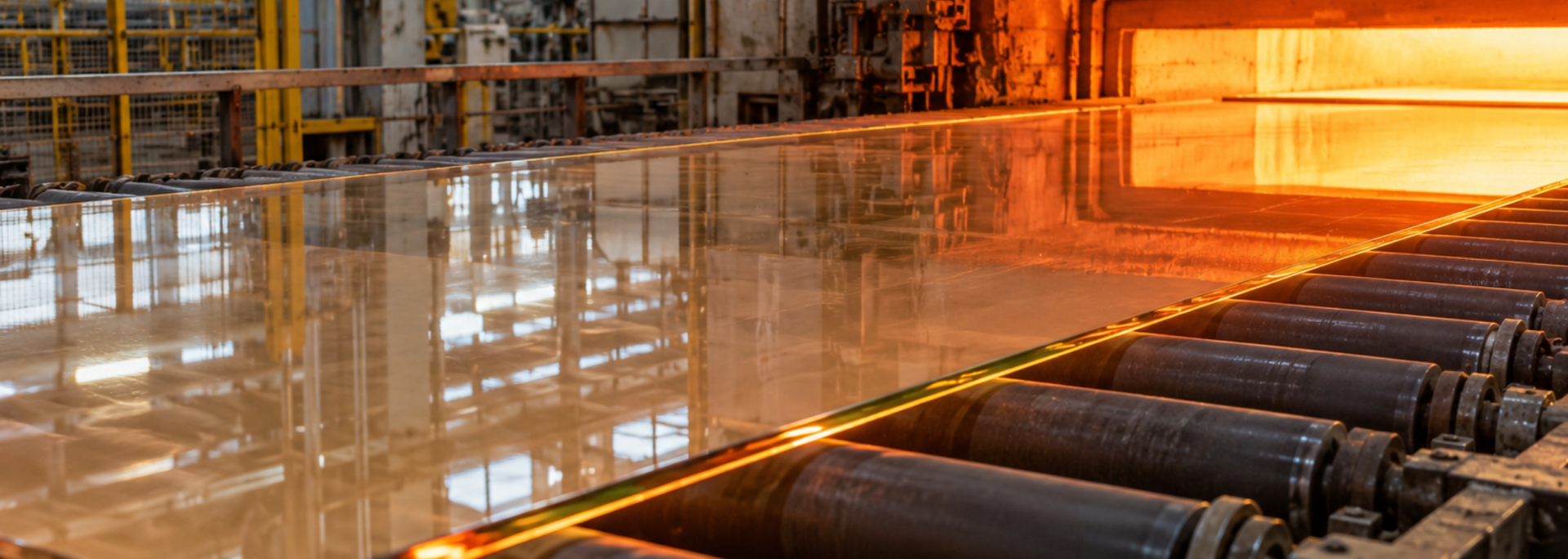
Glass, like every material, has an upfront carbon cost. And in the UK, glass production is among the most energy-intensive industrial sectors.
A recent analysis of the value chain within UK glass production called out two factors:
- Process
emissions: the fuel consumption of high-temperature furnaces to melt raw materials and achieve the clarity and consistency demanded by architectural applications
- End-of-life processing
The researchers estimate that 0.17kg of CO₂ could be created per kilogram of cullet (broken, scrap or recovered glass) when transporting and reprocessing. Again, that's why it's so important to consider the full carbon footprint when trying to understand the circularity of glass.
That being said, glass is still a more environmentally friendly choice compared to plastic, which can take centuries to decompose when sent to landfill.
Plus, as the report covers, there are plenty of benefits to using cullet even if reprocessing generates carbon emissions. First, it requires no additional energy consumption from sourcing raw materials.
And secondly, there are processing efficiencies because cullet – having already been processed once – doesn't require furnaces to operate at the temperatures needed for new glass.
So, it is still very much recommended that glass should be thought of as a circular material – and used as such.
Recyclable… but not easily recycled
At a material level, glass has an important advantage over cheaper materials such as plastic. It can be remelted and made into new glass without the fundamental material degradation many plastics experience.
Significant barriers to repurposing it remain, however. These are barriers that the industry is trying to overcome.
According to the report we cited earlier, only around 10% of new flat-glass production in the UK was estimated to be collected at end of life. Moreover, manufacturers typically used less than one percent post-consumer cullet. Instead, much of the collected material was downcycled rather than returned to new architectural glass.
But why is the gap so large?
According to an economic study conducted by Deloitte, the UK manufactures some 700,000 tonnes of flat glass yearly. Three-quarters of that consists of glazing products for buildings.
The report suggests several logistical and financial reasons why the glass we produce isn't as circular as it could be.
First, 700,000 tonnes per annum is a lot of glass. Deloitte's study suggests the UK's infrastructure is simply insufficient to treat and recycle large quantities of flat glass.
In general, treatment facilities do not collect skips more than 50 kilometres away from their treatment centre or, at least, from their storage facilities. That's because the transport cost outweighs the benefits of using cullet.
Even if glass recycling centres tripled overnight, this challenge would still exist because, by its very nature, glass is heavy to transport and bulky to handle.
A further problem hides here. Windows and facades are frequently removed alongside frames, sealants, coatings, fixings and other construction materials. Glass can be remelted without compromising quality, but only if demolition, collection and recovery processes are properly managed.
Poor project site management, the Deloitte report stresses, will result in a poor quality of collected glass.
Often, otherwise-usable glass is contaminated with bricks, metal cans, unacceptable forms of glass (bottles, heat-resistant containers, ceramics) and other rubbish. This presents a huge missed opportunity, considering the surface of offices could contain as much as 90% glass. Many offices, after all, now have full-height glazed facades.
So, unless the building demolition process ensures glass is carefully separated, collected and sorted, contamination could prevent the majority of recovered flat glass from being considered for recycling.
The challenge of composite products
Failing to properly separate glass from its fixtures feels like an easier challenge to address than the other reality. Namely, that architectural glass is often specifically designed to enhance the building's visual and functional performance.
One of the greatest selling points of architectural glass is the control it gives the designer over light, perception and temperature. However, the treatments involved can make the glass product more complex to recycle.
Laminated glass, widely used for safety and security, contains a plastic interlayer that holds fragments together if the glass breaks. This interlayer is commonly made of polyvinyl butyral (PVB).
This is an important safety benefit, but separating the materials at end-of-life is technically challenging. Residual glass, contamination, weathering and differences in PVB composition can all affect whether the recovered polymer is suitable for reuse.
Other composite constructions, including insulated glazing units (IGUs), coated products and glazing bonded into frames, also require careful consideration. Their performance benefits may be considerable, but designers should not assume that every component can be recycled using today's infrastructure.
A positive case for high-performance glazing
Although challenges exist, circularity must also account for what glass does during its working life.
In commercial buildings, high-performance glazing can help control heat transfer, manage solar gain, maximise useful daylight and support occupant comfort. While challenges remain with glass production and end-of-life handling, there's a lot to be said for the impact of high-quality glazing on energy use during the years in between.
At ToughGlaze, we know that we can't control what happens to our products after they reach the end of their life. However, we can strive to create products that deliver high performance while minimising environmental impact as much as possible.
Take TG SWITCH, our electrically switchable glass. It offers flexible privacy in a range of settings, yet has a power consumption of five watts/m².
And while glass processing accounts for only a small share of glass's total carbon impact, we've also taken steps to reduce our own carbon emissions. That includes implementing a unique water filtration system to safely reuse water from our preparation process.
Founded in 1993, ToughGlaze is a trusted UK glass processor. For more industry news and analysis, follow our blog.