
Non-slip glass floors: what are my options?
There are many things to consider when specifying non-slip glass floors. Learn how they work and what your options are.
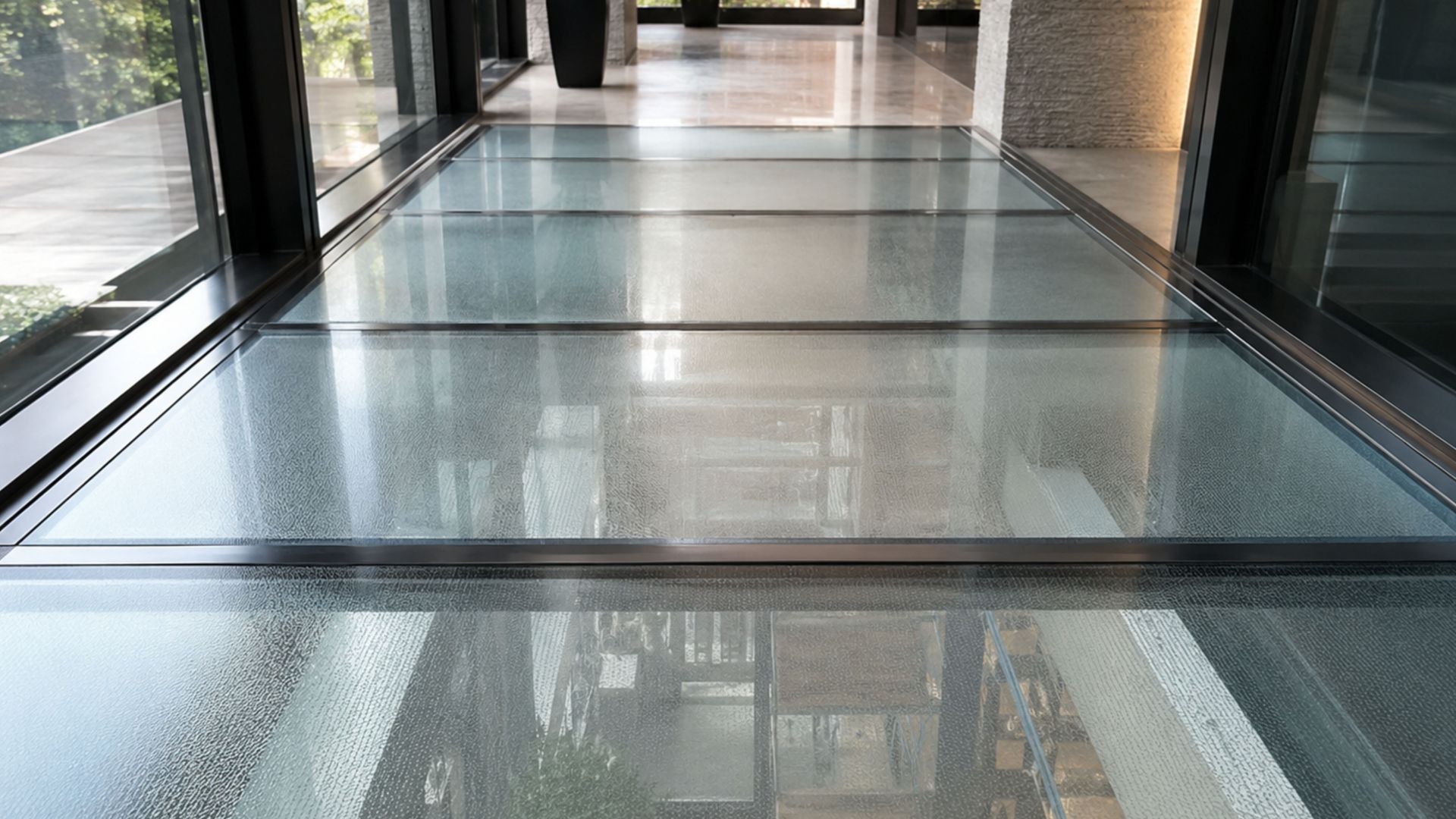
Glass floors have been around since the early 20th century. But glass floors that you can walk on are a 21st-century phenomenon.
This is partly thanks to the major advancements in safety glass in the late 20th century. Glass became stronger and safer than ever, and better able to withstand significant loads.
Today, walk-on glass floors are still far from common. Nevertheless, they're increasingly a high-end feature in hotels, apartment buildings, cultural institutions and more.
By their very nature, glass floors and walkways must support heavy foot traffic and, in some cases, furniture and other physical features. This is made possible by the layering of thick laminated and toughened sheets of safety glass.
And it's not just glass floors that can be walked on. Glass stair treads, mezzanines and even bridges can now support pedestrians.
When it comes to load-bearing glass, safety is crucial. This is to protect the people walking on it, of course. But it's also to protect the building owners from reputational damage (and non-compliance costs) in the event of a breakage.
That's why so many layers of safety glass are used in the construction of walk-on glass and why they're tested to withstand significant loads.
It's also why they're usually given anti-slip treatments. This is especially the case when the glass floor or walkway will be used in wet areas or where there's plenty of human traffic.
If you're specifying glass for a floor, you'll need to consider anti-slip treatments. So, what are your options? Let's find out.
What is anti-slip glass?
Usually, the names of glass products refer to the way the glass was manufactured. Annealed glass, toughened glass and laminated glass have been annealed, toughened and laminated, respectively. Sandblasted glass has been sandblasted. And so on.
Anti-slip glass, by contrast, belongs to those types of glass that are named after what they do rather than how they were made.
The glass itself will be laminated or laminated and toughened glass. It is rarely, if ever, a single pane. Instead, the unit is made from multiple thick layers of toughened glass bonded together with special interlayers.
This construction method means that it takes a considerable amount of force to break through the glass. If a pane does crack, the laminated construction helps retain the fragments and keep the panel in place, reducing the risk of falling glass and improving overall safety.
The phrase "anti-slip" refers to dotted or striped designs added to the glass. These can be applied using any of three methods:
- Ceramic frits
- Acid etching
- Sandblasting
When specifying safety glass for a walk-on floor, you'll need to choose between these three kinds of anti-slip treatment.
Types of anti-slip glass floor treatments
Ceramic frit
Ceramic frit patterns consist of ceramic materials screen-printed onto the glass and then fired at high temperatures. This means that the pattern is permanent, providing a textured, non-slip surface.
Acid etching
Acid etching has a rougher texture, but is still much smoother than sandblasted glass. The surface of the glass is etched with acid, creating a frosted appearance.
Sandblasting
Sandblasting involves blasting the glass with sand (often mixed with other granular materials) to create a translucent and gritty surface.
Which kind of non-slip glass floor should I choose?
All three kinds of anti-slip treatment have their advantages and disadvantages.
Acid-etched glass and ceramic fritted glass both offer strong anti-slip performance. Acid-etched glass is more durable and easier to clean than sandblasted glass, thanks to its superior smoothness, meaning that dirt doesn't get trapped as easily.
Ceramic fritted glass is highly customisable and performs well in wet conditions. The main drawback is that some people aren't keen on the dotted or patterned look and prefer the uniform satin finish of acid-etched glass.
Sandblasted anti-slip glass is the weakest of the three options. It wears away faster under foot traffic than ceramic fritted glass and acid-etched glass. It's also harder to clean because the gritty surface traps dirt. For this reason, it often needs sealing.
On the other hand, sandblasted glass has a lower upfront cost than acid-etched glass and ceramic fritted glass. It also has a pleasant frosted appearance that diffuses light well.
Where is anti-slip glass used?
Anti-slip glass is used for floors and walkways in museums, commercial buildings and residential properties. In some cases, it's used in the construction of standalone glass bridges. Examples include the Zhangjiajie Glass Bridge in China and the Grand Canyon Skywalk in the USA.
It's also used for glass stair treads and roof lights. In the latter case, this enables repairers and cleaners to safely access glass roofs and glass terraces.
Why is laminated glass used for non-slip glass floors?
Laminated glass – often made from laminated sheets of toughened glass – is used for non-slip glass floors for three main reasons:
- Its safety
- Its structural strength
- Its ability to contain damage by staying in its frame when broken
A walkable laminated glass panel consists of multiple layers of glass bonded together by a strong interlayer. In the event of breakage, the interlayer helps keep the glass fragments in place, reducing the risk of fallout and improving safety.
What we offer
Here at ToughGlaze, we provide a wide range of specialist safety glass products. If you're looking for walk-on glass floors with anti-slip treatments, TG WO is the way to go.
Like all our products, it's beautiful, it's made to the highest quality and it bears the Kitemark stamp for your peace of mind.
Best of all, our customers can choose between five pattern finishes, including dots and squares. At the time of writing, this is the biggest range of anti-slip patterned finishes in the UK.
Learn more about our walk-on glass products or get in touch with our experts to discuss your project and request a quote.