Glass in data centres: security, heat and performance considerations
Glass plays a critical role in data centre facilities across the world. Learn how it's used and how security is maintained.
There are around 12,000 data centres spread over nearly 200 countries. Together, they power the modern internet.
Data centres are complex places that use a wide range of materials to make everything from racks to servers to cooling systems.
They also use different kinds of glass. Primarily, this is used for optical fibre communications. However, glass is also used for screens and windows, and it contributes to heat and performance requirements.
As with any project, however, not any old glass will do. The glass used in data centres should be secure, thermally efficient and, in some cases, fire-rated for extra safety.
Before we take a look at these performance requirements, let's explore the main uses of glass in data centres.
How is glass used in data centres?
1. Fibre-optic cabling
Most modern data centres use glass optical fibres to transport data between servers, switches and storage systems.
These optical fibres are made from ultra-pure silica glass. Data travels along these fibres in the form of light pulses.
Glass is used rather than copper because of its higher bandwidth and ability to move data further distances.
Bigger hyperscale facilities have hundreds or even thousands of miles of fibre-optic cabling – and it wouldn't be possible without glass.
2. Optical transceivers and photonics
Glass is also used inside networking hardware for lenses, optical filters, fibre connectors and laser packaging windows. These devices convert electrical signals into light and back again.
3. Server room windows and observation panels
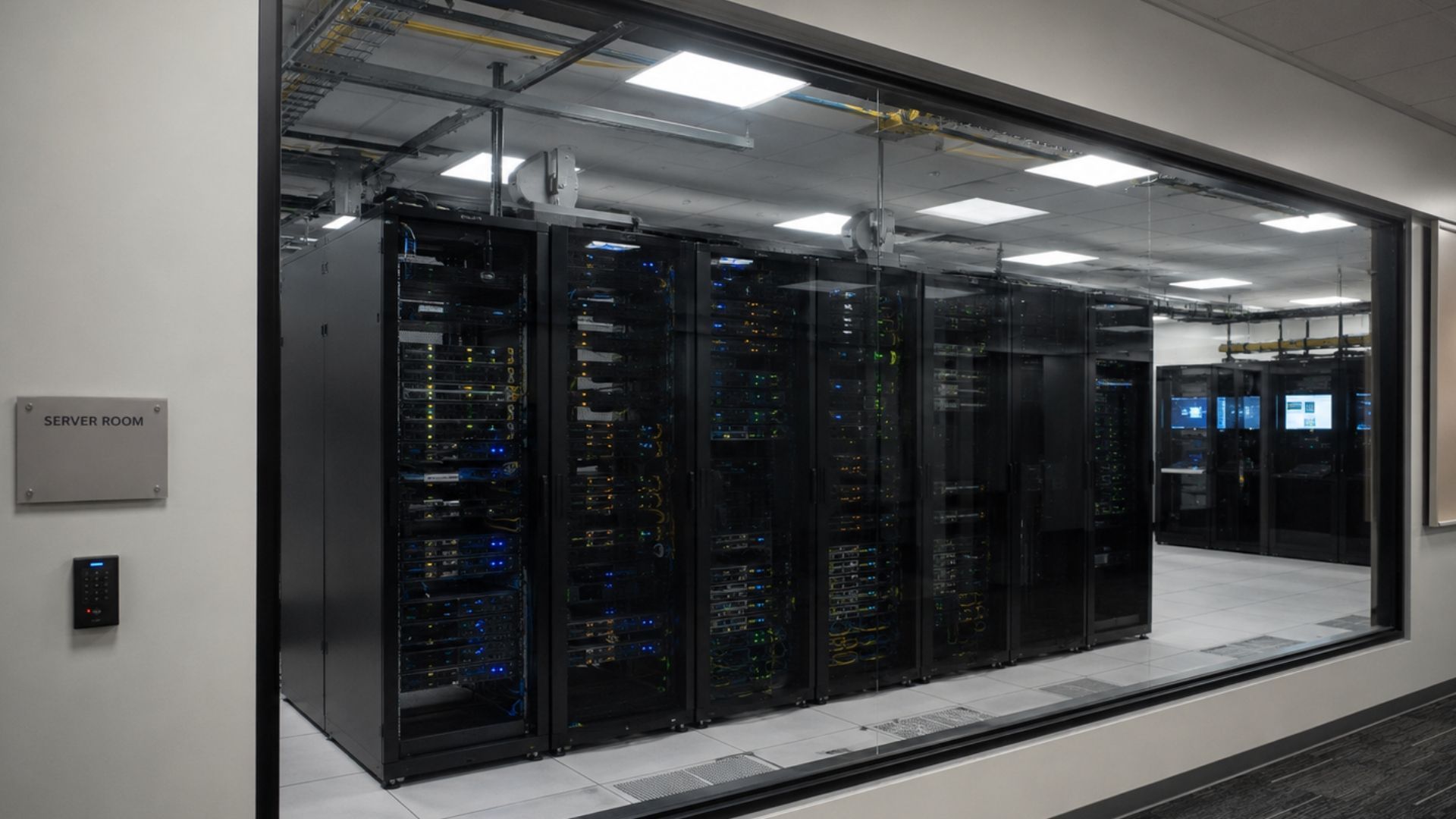
A more traditional use of glass in data centres is for server room windows, security viewing panels and control room partitions.
These screens and panels are typically made from laminated or toughened glass for security, durability and their safe breakage patterns.
4. Fire-rated and security glazing
Data centres frequently use specialist glazing for extra protection against fire, ballistics and manual attack. These include fire-resistant glass doors, blast-resistant glazing and secure vestibules.
5. Displays and monitoring systems
Computer monitors, consoles, dashboards and touchscreens – all are essential features of data centres, and all are made with glass.
6. Silicon photonics and optical switching
This is an emerging use of glass in data centres. Researchers are exploring technologies such as optical switching, silicon photonics and co-packaged optics. These systems use glass waveguides and other optical components to transmit data more efficiently, helping to lessen power consumption.
Security considerations
Security is a key consideration in the design and construction of data centres. This is because data centre owners need to keep a number of things secure: from the data itself to the different kinds of equipment that keep the digital economy running.
Every glass element in a data centre can be a weak security point – if, that is, inadequately secure glass is specified.
To stop unauthorised access, many data centres use laminated, reinforced or specialist security glass rather than standard commercial glazing. This stops intruders from accessing server rooms, network equipment and essential infrastructure.
As well as protecting physical equipment, security glass is used to keep sensitive information out of sight.
Without these precautions, a would-be intruder can observe rack layouts, equipment specs, infrastructure, security procedures and staff activities. Data centres often use translucent, opaque or tinted glass to stop intruders from scoping out facilities in this way.
All these precautions are taken to support one end: business continuity.
After all, data centres are used to prop up major services such as banks, government departments, healthcare providers, cloud services and telecommunication networks. If corners are cut in the specification of glass, downtime becomes more likely.
The final security consideration for data centres is keeping staff safe.
When ordinary glass shatters, it can cause injury. This is why data centres (like so many other facilities) often use toughened or laminated glass.
When toughened glass breaks, it shatters into lots of tiny, relatively. harmless pieces. When laminated glass breaks, it's designed to hold the glass pieces together and maintain a degree of structural integrity. These distinctive post-breakage behaviours make toughened and laminated glass ideal for data centre applications.
How does glass help regulate heat in data centres?

Heat control is a major issue in data centres – and while cooling equipment is the key issue, glass also plays a role.
This is because glass can control the flow of heat between inside and outside. Modern data centres often use specialised glazing systems to minimise unwanted heat gain from sunlight and reduce heat loss in colder weather.
Laminated glass is used to minimise heat loss, as are double- and triple-glazed units. These trap air or inert gas between the panes, helping the building to stabilise its temperature.
Heat control is largely about thermal performance. But this isn't a purely technical issue. It also impacts directly on staff comfort in office areas, control rooms and other spaces within the data centre.
What are the performance requirements for glass in data centres?
Glass in data centres serves multiple purposes. It supports security, energy efficiency and business continuity.
In some cases, glass needs to provide high levels of impact resistance, whether against bandits, bullets or bombs. The precise specification will depend on the location and nature of the facility.
Thermal performance is important, too. Thermally efficient glass is used to improve energy efficiency and reduce cooling loads.
Often, the glass used for screens and windows in data centres is fire-rated to help contain fire and smoke in the case of an emergency.
Another use case for glass in a data centre is soundproofing. Data centres are noisy places, meaning that thicker glass types are often used to limit how far sound can travel.
The glass used in data centres often needs to be resistant to weathering. Glass that's not built for weather resistance can cause condensation, mould and other issues.
Finally, privacy is often a concern in data centres. Prying eyes can be kept away with sandblasted or otherwise coated glass to limit visibility.
Since 1993, ToughGlaze has supplied specialised glass products to leading architecture and construction firms. Explore glass industry applications or get in touch with our experts to discuss your next project in detail.