A guide to temporary protection for glass during construction
Even the highest quality glass can break. Find out how to protect it on construction sites in our industry guide.
We all know construction sites can be hazardous places to work. But it's not just people that must be protected. It's also materials.
This is especially true for glass. Modern glazing is tougher than ever – but that doesn't mean it's indestructible.
Glass on construction sites can be damaged by everything from scratches to knocks, from dust to paint. So, how do you protect it on-site?
A great place to start, of course, is with high-quality glass that has high impact resistance. But even this needs protection to avoid costly replacements and project delays.
In this article, we explore common methods for protecting glass in a range of construction settings.
Glass protection methods for construction sites
There are five common temporary protective systems on construction sites:
- Protective film
- Corrugated plastic sheets
- Plywood or oriented strand board (OSB) hoarding
- Temporary glazing guards
- Masking tape
1. Protective film
Protective adhesive polyethylene films can be directly applied to the glass. This is good for protecting the glass against dust, paint and sun exposure. However, it's not substantial enough to protect against heavy impact.
2. Corrugated plastic sheets
Construction teams often fix corrugated plastic sheets to the glass, leaving an air gap whenever possible. This is a go-to method that works well for general protection.
For extra impact protection, people often use corrugated plastic sheets alongside a layer of foam.
3. Plywood or OSB hoardings
A similar method is the use of plywood or OSB hoardings – rigid barriers between the glass and tools, materials, people and machines. The difference compared to using foam is that the hoarding doesn't touch the glass.
4. Temporary glazing guards
Temporary glazing guard systems can be installed around windows, doors and curtain walls. This is especially common on commercial construction sites.
5. Masking tape
Finally, construction teams will sometimes use masking tape around frames and seals to protect the glass from paint, dust and scratches. It's important to note, however, that this is insufficient against impacts. Moreover, some tape products can damage the glass.
What are the most appropriate temporary protection methods for glass on house-building sites?

Different construction sites have different requirements. In the case of house-building, construction teams will likely apply glazing protection film to protect against plaster, paint, mortar, dust and other contaminants.
If work is happening close to the glass, more rigid protection will be used – often corrugated sheets. The sheet shouldn't touch the glass and should be self-supporting.
If there's a significant risk of impact – from masonry or power tools, for instance – teams will often deploy a plywood or OSB barrier. Different protection methods should be used for frames and thresholds.
If using masking tape, it's important to be careful when applying it to aluminium, uPVC and powder-coated finishes as there's a risk of surface damage.
What are the most appropriate temporary protection methods for glass on commercial construction sites?
As with house-building, commercial construction sites often use temporary protective films to protect the glass from dust, paint, plaster, mortar and scratches. If laminated glass or coated glass is used, it's important to check that the film is compatible.
Corrugated walls can act as a rigid barrier against impact in front of glass that's vulnerable to impact. In especially vulnerable settings, you should use a cushioned plywood or OSB barrier instead of a plastic sheet.
As mentioned, this plywood or OSB barrier should be self-supporting and not touch the glass – no matter how sturdy the glazing.
Glass around the perimeter should be protected. This includes frames, sills and thresholds. Each should be protected separately.
Any glass located near vehicles, lifting equipment or material storage can be placed in an exclusion zone – an area surrounded by a barrier or hoarding. Vehicles shouldn't go near the glass wherever possible.
What are the most appropriate temporary protection methods for glass near scaffolding or brickwork?
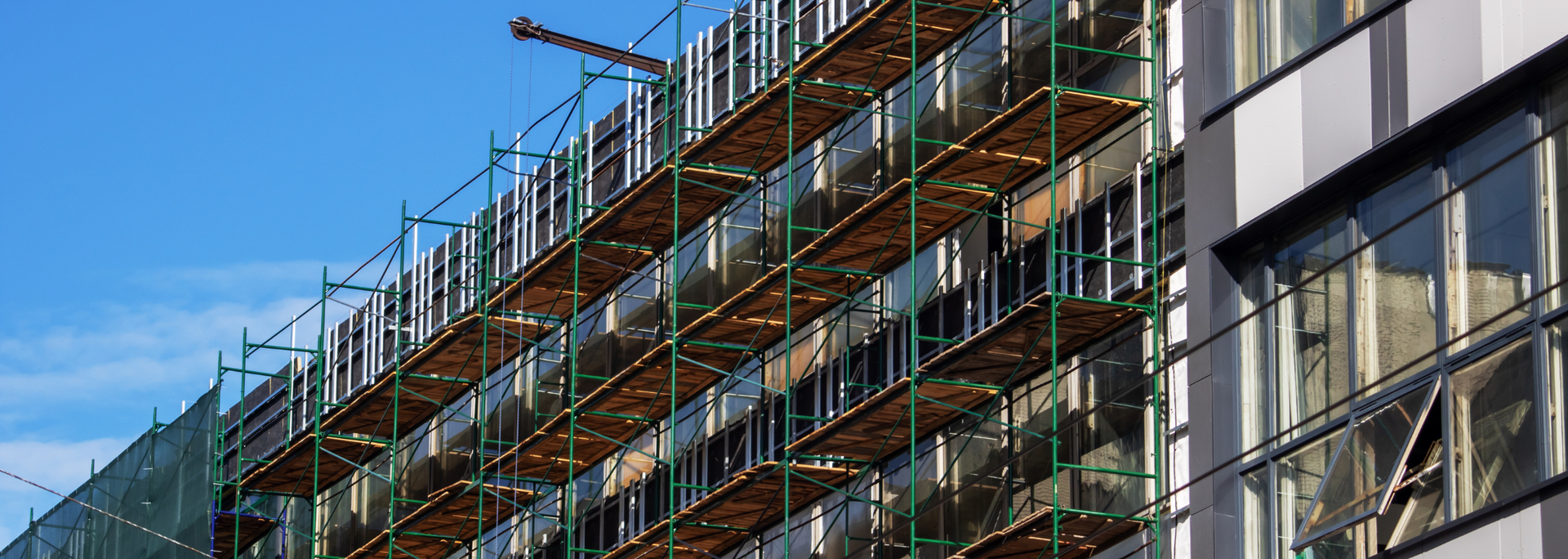
Glass near scaffolding or brickwork should be covered with a protective film. This protects the glass against mortar, dust, render and paint.
If there's a risk of falling bricks or impacts from tools or scaffold components, you can use a rigid plywood or OSB board for extra protection.
As in all settings, it's important to keep a small cushioned gap between the glass and any rigid board. This stops impacts from being transferred to the pane and potentially breaking it.
Any surrounding barrier should be fixed onto or supported by the scaffold – not attached in any way to the glass.
If the scaffolding is directly in front of the glazing, a large temporary screen or hoarding between the work area and the glass is advisable. This will offer far more protection than a plastic film or masking tape.
Transporting glass on a construction site
Glass isn't only damaged on construction sites by impacts. It can also suffer damage during transportation.
You can avoid this by using proper handling tools and personal protective equipment (PPE). Edges and corners should be protected with foam, rubber or cork. Weights should be evenly distributed and loads secured with non-crushing straps.
Why does material quality matter?
Not all kinds of glass are created equal. Some are more durable than others. In an environment like a construction site, this can make a big difference.
High-quality glass offers superior impact resistance. This is especially true of safety glass – our speciality here at ToughGlaze.
Toughened glass (sometimes known as "tempered glass") is up to five times as strong as standard annealed glass, while laminated glass is up to six times as strong.
All kinds of glass can break – and no amount of temporary protection methods can change that. But if you want to reduce the risks of breakage on-site, investing in the best materials is essential.
Are you looking for high-quality glass for construction? At ToughGlaze, we've cut, processed and delivered glass for the construction industry since 1993. Contact our team to discuss your needs or request a quick, competitive quote.